.gif)
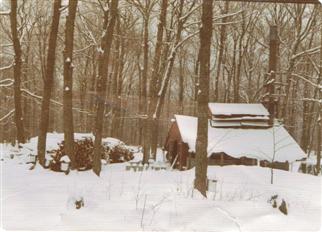
Maple Syrup Cooking House, 1945
Maple Syrup Cooking House, 1945
In the early spring of 1926, our grandfather William Simpson and his partner Ed Hunt, both from Birchwood Wisconsin, snowshoed and skied to their sugar camp from the Soo Line depot at Leighhigh. It was about 2 miles as the crow flies, but more because of the steep hills, deep snow, and provisions that were being packed in to further the supplies that had been previously left at the camp. Thiis was the first year our Grandparents made syrup from the land they had recently purchased in the Blue Hills, east of Rice Lake. Geologists recognize the Blue Hills as what remains of a mountain range that is older than the Rockies.
Why did our grandfather call his Sugar Bush "Rocky Ridge"? When asked this question our father used to tell the story of a neighbor who was one of the early settlers of the area. He purchased his land in the winter, drove a rod into the ground to check for rocks. He found none, and spent the rest of his life looking for that spot. Seriously, its next to impossible to put a shovel into the ground. The silver lining is that it’ also impossible to sink your trailer, tractor, or horse when picking up sap.
After our grandfather died, his wife, Ruth Simpson, continued to operate the Sugar Camp as she called it for 26 years until her death in 1967. Operation then continued by her son William and grandchildren. In her syrup journal she wished that maybe someday one of the grandkids would run the camp. She got her wish. We have continued to make Simpson’s Rocky Ridge Maple Syrup, despite a setback in 1994, when a wind in spring took out over 70% of the main bush. Our buildings remained almost undamaged, which we took as a sigh to continue our grandparents and parents tradition.
Because of our encouragement of young maples through timber stand improvement, we now have a good supply of young maple, along with many of the same trees that our grandparents tapped in in 1926. We hope to be able to continue to help nature provide a quality product at an affordable cost to customers for many years to come.
.jpg)
Maple Syrup Cooking House, 2005
In the 1930's our Father, William Simpson, acquired a Bell and Howell movie camera and began taking home movies. The following is a home movie he make in 1939 of gathering Sap in our family's Maple Sugar bush using our horse Dolly.
Home Movie showing Gathering Sap in the 1930s